
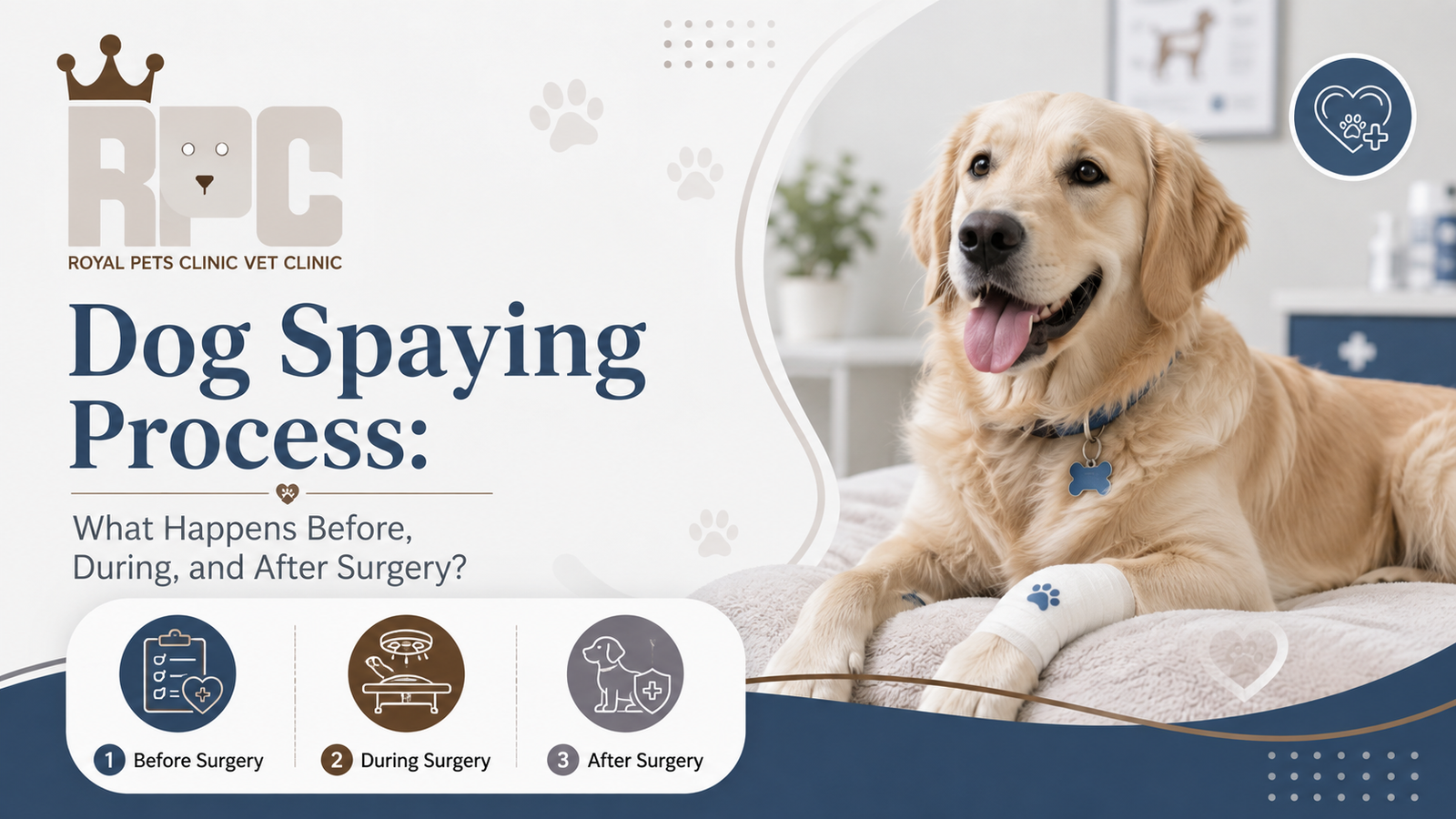
Understanding the dog spaying process can make the decision feel less stressful for both you and your pet. Many owners know that spaying prevents pregnancy, but they may still feel anxious about anesthesia, the surgical procedure, pain control, incision care, and the recovery period.
Spaying is a commonly performed operation carried out under general anesthesia. It usually involves removing the ovaries and, depending on the surgical method and the dog’s condition, may also involve removing the uterus. Your dog receives anesthesia to remain unconscious during the operation, along with appropriate medication to manage pain before, during, and after surgery.
Every dog is different, so the exact procedure, preparation instructions, and recovery plan should be determined by a veterinarian. At Royal Pets Veterinary Clinic Abu Dhabi, experienced veterinary professionals can assess your dog, answer your questions, and provide a treatment plan based on her age, breed, weight, lifestyle, and general health.
What Is the Dog Spaying Process?
The dog spaying process is a surgical method of sterilizing a female dog so that she cannot become pregnant or continue having heat cycles.
The two procedures commonly associated with spaying are:
- Ovariectomy: The ovaries are removed.
- Ovariohysterectomy: The ovaries and uterus are removed.
The method selected depends on the veterinarian’s surgical approach, the dog’s individual circumstances, and any medical findings. This means that spaying does not always involve removing both the ovaries and uterus; in some procedures, only the ovaries are removed.
Spaying is more than the operation itself. The full process includes:
- A pre-surgical consultation
- A health examination
- Pre-anesthetic preparation
- General anesthesia
- Surgical sterilization
- Incision closure
- Monitored recovery
- Home aftercare and follow-up
Knowing these stages in advance helps you prepare your home, arrange supervision, and recognize when your dog may need additional veterinary attention.
Why Is a Pre-Spay Consultation Important?
Before arranging surgery, your dog should have a professional veterinary assessment. Spaying may be routine, but it is still an abdominal surgical procedure that requires careful planning.
During the consultation, the veterinarian may review:
- Your dog’s age and breed
- Current weight and body condition
- Previous illnesses or operations
- Current medicines and supplements
- Previous reactions to anesthesia
- Heat-cycle history
- Possibility of pregnancy
- Appetite and energy levels
- Recent vomiting, diarrhea, coughing, or other symptoms
The timing of spaying should be individualized. There is no single ideal age that applies to every female dog because breed, expected adult size, lifestyle, reproductive history, and medical considerations can affect the recommendation.
A consultation at Royal Pets Veterinary Clinic Abu Dhabi gives you an opportunity to discuss these factors with an experienced veterinarian instead of relying on general online recommendations.
Before the Dog Spaying Surgery
Pre-Anesthetic Health Check
Before the procedure, the veterinary team examines your dog and confirms her weight. Accurate weight information is important because anesthetic and pain-control plans are developed for the individual patient.
The examination may include checking:
- Heart rate
- Breathing
- Temperature
- Gum color
- Hydration
- General physical condition
- Signs of illness
- The stage of the reproductive cycle
Laboratory testing may also be recommended to provide information about your dog’s health before anesthesia. Blood testing can help the veterinarian assess important health indicators and determine whether further investigation is needed.
في Royal Pets Veterinary Clinic Abu Dhabi, laboratory testing is available for accurate health insights. If the veterinarian identifies a concern, additional diagnostics such as X-ray imaging, ultrasound, or echocardiography may be considered when clinically appropriate.
These services allow the veterinary team to evaluate your dog more thoroughly rather than treating every patient as though they have identical needs.
Tell the Veterinarian About Health Changes
Contact the veterinary team before the appointment if your dog:
- Becomes unwell
- Stops eating
- Develops vomiting or diarrhea
- Starts coughing
- Appears unusually tired
- Begins a heat cycle
- May be pregnant
- Receives a new medication
Do not hide a health concern because you are worried the operation may be postponed. Delaying an elective procedure can sometimes be the safest choice when a dog is unwell.
Food and Water Instructions
Owners are often told not to feed their dogs on the morning of surgery. However, you should follow the exact fasting instructions provided by your veterinary team rather than using one universal schedule.
Adult dogs are commonly asked to stop eating after a specified time the night before surgery. Instructions about water may be different, and special guidance may be required for puppies, small dogs, diabetic dogs, or pets with certain medical conditions. General veterinary preparation guidance permits water for part of the morning in many cases, demonstrating why owners should not automatically remove both food and water without receiving specific instructions.
Do not give treats, table scraps, milk, or chewable foods after the fasting period begins unless the veterinarian has approved them. You should also ask whether your dog’s regular medication should be administered on the day of surgery.
What Happens During the Dog Spaying Process?
1. Admission and Final Assessment
When your dog arrives, the team confirms that the preparation instructions were followed. You may be asked about:
- Her last meal
- Her last drink
- Any medication given
- Recent health changes
- Her most recent heat cycle
- Emergency contact details
The veterinary team may repeat parts of the physical examination before preparing her for surgery.
2. Sedation and General Anesthesia
Your dog is given medication to help her relax before general anesthesia. Depending on the treatment plan, an intravenous catheter may be placed to provide medication and fluids.
General anesthesia means that your dog is deeply unconscious during surgery. She should not be aware of the procedure, and pain-control medication is incorporated into the treatment plan to support her comfort. Anesthetized patients need close monitoring throughout the operation and as they begin waking up.
The veterinary team may monitor important measurements such as:
- Heart rate
- Breathing rate
- Oxygen levels
- Blood pressure
- Body temperature
- Response to anesthesia
3. Surgical Preparation
Once your dog is anesthetized, hair is clipped from the surgical area. The shaved section may look larger than owners expect because the team needs enough space to prepare and maintain a clean operating field.
The skin is cleaned with appropriate surgical solutions, and sterile materials are positioned around the operation site. These steps help maintain an aseptic surgical environment.
4. Surgical Access
For a conventional open spay, the veterinarian makes a carefully controlled incision along the abdominal area to access the reproductive organs.
The size of the incision can differ according to:
- The dog’s size
- Body condition
- Surgical technique
- Reproductive status
- Individual anatomy
- Findings during surgery
A laparoscopic or keyhole approach is different. It uses smaller access points and specialized equipment to perform an ovariectomy. Not every dog is necessarily suitable for the same approach, so the appropriate option should be discussed during consultation.
5. Removal of the Reproductive Organs
During surgery, the ovaries are identified and removed. In an ovariohysterectomy, the uterus is also removed.
Associated blood vessels and tissues are securely sealed or ligated to control bleeding. The veterinarian then checks the surgical area before closing the incision.
The duration of the surgical portion can vary considerably. A routine procedure may take approximately 20 to 90 minutes, but the total time your dog spends at the veterinary facility is usually longer because it includes admission, preparation, anesthesia, monitoring, and recovery.
A longer procedure does not necessarily mean something has gone wrong. The dog’s size, health, reproductive status, surgical method, and individual anatomy can all influence the time required.
6. Closing the Incision
The abdominal incision is normally closed in several layers. The veterinarian may use:
- Internal dissolvable sutures
- Buried skin sutures
- Visible external stitches
- Surgical staples
- Medical-grade tissue adhesive
Ask the veterinary team which closure method was used and whether your dog will need an appointment for stitch or staple removal.
7. Waking Up After Anesthesia
After surgery, your dog is moved to a monitored recovery area. The team observes her breathing, temperature, alertness, comfort, and incision while she wakes.
Some dogs may initially appear:
- Sleepy
- Unsteady
- Quiet
- Mildly confused
- Less interested in food
The team will assess whether your dog is recovering appropriately before deciding when she can return home. Some patients may require longer observation or medical boarding depending on their condition.
Royal Pets Veterinary Clinic Abu Dhabi provides safe medical boarding for pets that require extended professional care, giving owners additional reassurance when continued monitoring is considered necessary.
Is the Dog Spaying Process Painful?
Your dog is unconscious under general anesthesia during the operation, and pain-control medication should be part of her surgical care. However, spaying is still abdominal surgery, so some soreness can be expected during recovery.
The goal is not to pretend that your dog will feel nothing after surgery. The goal is to keep discomfort appropriately controlled and recognize signs that could indicate worsening pain.
Possible signs of pain include:
- Restlessness
- Difficulty settling
- Reluctance to stand
- Guarding the abdomen
- Rapid breathing while resting
- Vocalization
- Refusing food
- Unusual aggression
- Shaking or trembling
- Repeatedly looking at the incision
Give only the pain medicine prescribed by the veterinarian, following the correct dose and schedule. Never give your dog human pain medication unless a veterinarian specifically instructs you to do so. Some medicines commonly used by people can be dangerous or toxic to dogs.
Contact the veterinary team if your dog appears very uncomfortable or if her pain seems to be increasing rather than improving.
Dog Spay Recovery: The First 24 Hours
The first evening should be quiet and closely supervised. Prepare a comfortable space away from children, stairs, slippery floors, and energetic animals.
Your dog may want to sleep more than usual after arriving home. Follow the discharge instructions regarding when and how much food and water to offer.
A small meal may be recommended rather than a large portion, but individual instructions can vary. Contact the veterinary team if your dog repeatedly vomits, cannot keep water down, or remains unusually unresponsive.
Take her outside only for short toilet breaks on a lead. Do not allow free running, rough play, or jumping onto furniture.
Before going to sleep, check:
- Whether she has taken her prescribed medicine
- Whether the incision remains closed
- Whether there is active bleeding
- Whether she is breathing comfortably
- Whether the protective collar remains securely fitted
The Two-Week Dog Spay Recovery Period
Many dogs need approximately 7 to 14 days of restricted activity while the incision begins healing. The exact period depends on the procedure, closure method, and the veterinarian’s instructions.
Even if your dog seems energetic after a few days, the internal tissues still need time to heal.
During the recovery period:
- Keep walks short and controlled
- Use a lead for toilet breaks
- Prevent running and jumping
- Avoid rough play
- Limit access to stairs
- Do not allow swimming
- Do not bathe your dog
- Keep the incision clean and dry
- Attend scheduled follow-up appointments
Increasing exercise too quickly can place stress on the healing tissues and increase the risk of swelling, bleeding, or incision damage.
Prevent Your Dog From Licking the Incision
Licking may irritate the skin, introduce bacteria, damage stitches, and delay healing. Your dog should wear the protective device recommended by the veterinary team.
This may include:
- An Elizabethan collar
- A properly fitted protective cone
- A veterinary recovery suit
Protective equipment may be needed for 7 to 14 days, depending on the wound and the veterinarian’s advice. It should remain in place whenever your dog could reach the incision, including overnight and when she is unsupervised.
Do not assume that brief licking is harmless. Dogs can damage an incision surprisingly quickly.
How to Monitor the Spay Incision
Check the incision at least once daily or as directed. It can help to take a clear photograph each day under similar lighting so that you can identify changes.
A healing incision should generally remain closed and gradually look less irritated. Some mild redness or localized swelling may occur early in recovery, but it should not progressively worsen.
Do not put alcohol, hydrogen peroxide, creams, powders, oils, or antiseptic products on the incision unless the veterinarian has instructed you to use them. Unapproved products may irritate tissue or delay healing.
When Should You Contact the Veterinarian?
تواصل معنا Royal Pets Veterinary Clinic Abu Dhabi promptly if you notice:
- Increasing redness
- Significant or worsening swelling
- Heat around the incision
- Yellow, green, or foul-smelling discharge
- Persistent bleeding
- Missing or damaged stitches
- Separation of the incision edges
- Repeated vomiting
- Severe diarrhea
- Refusal to eat beyond the advised period
- Extreme or worsening lethargy
- Difficulty urinating
- Uncontrolled pain
- Persistent licking despite protection
Seek urgent veterinary attention if your dog develops:
- Difficulty breathing
- Collapse
- Pale or white gums
- Unresponsiveness
- Uncontrolled bleeding
- Rapid abdominal swelling
- An open surgical wound
- Severe weakness
You do not need to wait for a scheduled follow-up appointment when something appears wrong. Early communication allows the veterinary team to advise you on the safest next step.
Preparing Your Home Before Surgery
A little preparation can make the dog spaying process easier when your pet returns home.
Before the appointment, arrange:
- A quiet sleeping area
- Clean, comfortable bedding
- Non-slip flooring
- Barriers around stairs
- Separation from active pets
- A suitable protective cone or suit
- Easy access to an outdoor toilet area
- A written medicine schedule
- Emergency contact information
You may also need to adjust your routine so that someone can supervise your dog closely during the first evening and regularly throughout recovery.
Why Choose Royal Pets Veterinary Clinic Abu Dhabi?
Choosing where to arrange your dog’s surgery is an important decision. You need more than an appointment—you need a veterinary team that takes time to assess your pet, explain the process, and support you after she returns home.
Royal Pets Veterinary Clinic Abu Dhabi offers a warm, pet-friendly environment in Khalifa City, near El Ethad Plaza, Building C65, next to Life Pharmacy. The location extends the trusted standard of care established by its Dubai branch while providing convenient access for pet owners in Abu Dhabi.
The clinic provides a comprehensive range of veterinary services, including:
- Professional veterinary consultations
- Laboratory testing
- X-ray imaging
- Ultrasound examinations
- Echocardiography
- الإجراءات الجراحية المتقدمة
- Safe medical boarding
- Dental scaling
- Grooming and personal care
These capabilities can be particularly valuable when planning surgery. Laboratory testing supports pre-anesthetic health assessment, while imaging and cardiac evaluation are available when a dog requires further investigation. Medical boarding also provides an option for pets that need extended care or observation.
The clinic’s veterinarians and veterinary technicians bring professional training and practical experience to every stage of your pet’s care. From the first consultation to postoperative monitoring and recovery advice, the team is committed to treating pets with patience and compassion.
Questions to Ask at a Dog Spay Consultation
Preparing a list of questions can help you make a confident, informed decision.
Consider asking:
- Is now an appropriate time to spay my dog?
- Which spaying method do you recommend?
- Will the ovaries only or the ovaries and uterus be removed?
- Is pre-anesthetic blood testing recommended?
- What should my dog eat or drink before surgery?
- Should she take her regular medication?
- How will she be monitored under anesthesia?
- Which pain medicine will she receive?
- How long is the expected recovery period?
- Which protective collar or suit should she wear?
- When should the incision be checked?
- Will her stitches need to be removed?
- Who should I contact if I am worried after surgery?
A caring veterinary team should be willing to explain the procedure in understandable language and address your concerns before you provide consent.
FAQ About the Dog Spaying Process
How long does the dog spaying process take?
The surgical portion may take approximately 20 to 90 minutes, although the actual duration varies. Your dog will normally remain at the veterinary facility longer for admission, preparation, anesthesia, recovery, and observation.
Does spaying always remove the uterus?
No. An ovariectomy removes the ovaries, while an ovariohysterectomy removes the ovaries and uterus. Your veterinarian can explain which method is recommended for your dog.
Can my dog eat on the morning of surgery?
Most dogs are asked not to eat on the morning of an operation, but you should follow the specific instructions provided by the veterinary team. Puppies and dogs with certain medical conditions may receive different instructions.
Can my dog drink water before spaying?
Water instructions vary. Do not remove water earlier than advised, and do not assume that food and water have the same cutoff time. Confirm the exact instructions during your consultation.
How long should my dog wear a cone after being spayed?
Many dogs need wound protection for approximately 7 to 14 days. Your dog should continue wearing it until the veterinarian confirms that the incision has healed sufficiently.
Can my dog walk after spay surgery?
Short, controlled lead walks for toileting are usually allowed, but running, jumping, rough play, and strenuous exercise should be avoided during the advised recovery period.
When can my dog return to normal activity?
Many postoperative plans restrict activity for approximately 7 to 14 days. The correct time depends on healing progress, the procedure performed, and the veterinarian’s instructions.
What should I do if my dog licks her stitches?
Replace or adjust the protective cone immediately and inspect the incision. Contact the veterinary team if stitches are damaged, the wound has opened, or you notice bleeding, swelling, or discharge.
Take the Next Step With Confidence
Learning about the dog spaying process is an excellent first step, but online information cannot determine the right timing, surgical method, or anesthetic plan for an individual pet.
A professional consultation allows your dog’s health to be assessed and gives you the opportunity to discuss preparation, anesthesia, pain management, recovery, and possible risks before making a decision.
تواصل معنا Royal Pets Veterinary Clinic Abu Dhabi to arrange a consultation for your female dog. The experienced team can guide you through each stage with clear information, compassionate handling, advanced veterinary support, and a recovery plan tailored to your pet.
Your dog depends on you to make thoughtful choices about her health. With professional guidance and careful preparation, you can approach her spaying procedure feeling informed, supported, and ready to provide the care she needs.