

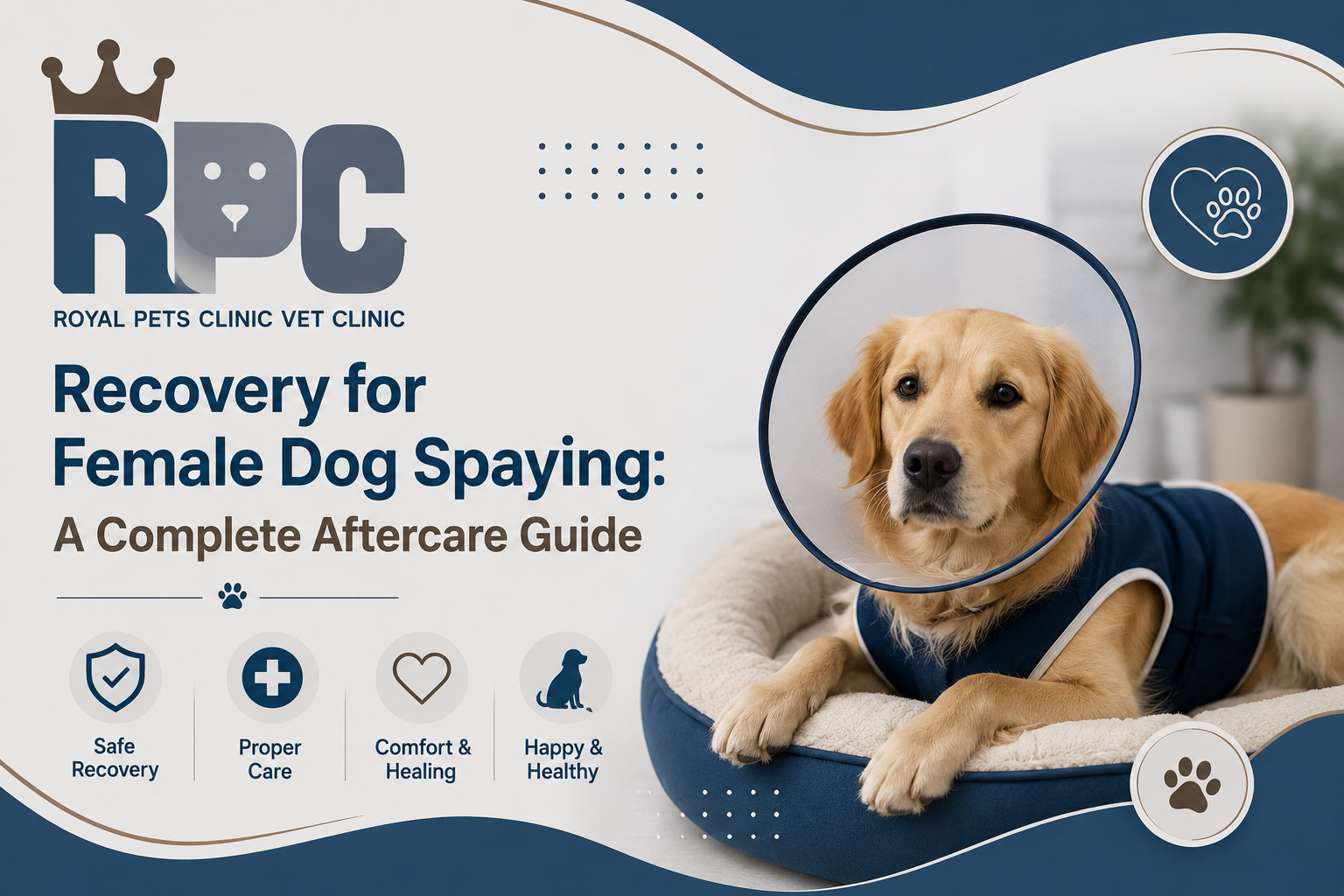
Bringing your female dog home after spay surgery can be an emotional experience. You may feel relieved that the procedure is complete while also worrying about every change in her behavior, appetite, movement, or incision.
A safe recovery for female dog spaying depends on careful rest, controlled movement, incision protection, prescribed medication, and close observation. Although your dog may begin acting energetic within only a few days, her body still needs time to heal beneath the skin.
Most dogs require approximately 10 to 14 days of protected recovery after routine spay surgery. The exact timeline can vary according to your dog’s age, health, activity level, surgical procedure, and veterinary instructions. This is why following the individual aftercare plan provided by your veterinarian is more important than relying on a general timeline alone. Veterinary guidance commonly recommends preventing running and jumping for up to two weeks while the incision heals.
If you are preparing for your dog’s surgery or are concerned about her recovery, the experienced team at Royal Pets Veterinary Clinic Abu Dhabi can provide professional guidance, surgical care, post-operative consultations, and support throughout the healing process.
How Long Does Recovery for Female Dog Spaying Take?
The visible incision may begin to look better within several days, but this does not mean your dog has healed completely. Spaying is an abdominal surgical procedure, so tissues beneath the skin also need time to recover.
You should generally plan for around two weeks of careful supervision and restricted activity. During this period, your dog should not run, jump, wrestle with other pets, climb onto furniture, or take long walks.
Some dogs appear sleepy and quiet for the first day, while others quickly regain their normal energy. An energetic dog still needs the same protection as a tired dog. Too much movement can place pressure on the surgical area, increase swelling, delay healing, or cause the incision to open.
Recovery may take longer when a dog has an existing medical condition, is overweight, is highly active, has undergone a more complicated procedure, or has irritated the incision by licking or excessive movement. Contacting Royal Pets Veterinary Clinic Abu Dhabi allows you to receive advice based on your dog’s individual condition rather than guessing whether her recovery is progressing normally.
The First 24 Hours After Spay Surgery
The first night is usually the period when owners feel most anxious. Your dog may appear sleepy, quiet, unsteady, or less interested in food as the effects of anesthesia wear off.
Prepare a calm indoor space where she can rest without being disturbed by children, visitors, or other pets. Her bed should be clean, comfortable, and positioned at floor level so she does not need to climb or jump.
Keep her warm but avoid excessive heat. Watch her breathing, responsiveness, movement, and comfort. She should gradually become more alert rather than becoming weaker or more difficult to wake.
Feeding Your Dog on the First Night
Unless your veterinarian gives different instructions, offer a smaller meal when your dog returns home. A half-sized portion of her familiar food is often recommended initially. If she eats without vomiting and appears comfortable, she may usually return to her normal diet the following day.
Avoid table scraps, rich treats, milk, unfamiliar foods, or sudden dietary changes. Her appetite should gradually improve within approximately 24 hours. Persistent loss of appetite, vomiting, diarrhea, or worsening lethargy should be discussed with a veterinarian.
Fresh water should normally remain available, but always follow the specific discharge instructions given for your dog.
Female Dog Spay Recovery During Days Two to Seven
During the next several days, your dog may start behaving more like herself. This is encouraging, but it is also the stage when owners may accidentally allow too much activity.
Continue keeping her in a controlled environment. When you cannot supervise her, use a suitably sized crate, playpen, or small quiet room if recommended by the veterinarian. She should have enough room to stand, turn around, lie comfortably, and access water.
Your focus during the first week should be simple:
- Keep her calm.
- Prevent running and jumping.
- Protect the incision from licking.
- Give medication as prescribed.
- Check the wound consistently.
- Contact the veterinarian if symptoms worsen.
Even if she appears excited and wants to play, extending her rest period is far safer than allowing activity too soon.
Days Eight to Fourteen: Do Not Rush the Final Stage
By the second week, the incision may look much better and your dog may have returned to her usual personality. However, this is not automatically permission to resume normal walks, running, rough play, daycare, swimming, or jumping onto furniture.
Continue following the activity restriction period provided by your veterinarian. External stitches or staples, when present, may need to be removed during a follow-up appointment. Other dogs may have dissolvable sutures beneath the skin.
A veterinary check can confirm whether the wound is healing properly and whether your dog is ready to return to normal exercise. At Royal Pets Veterinary Clinic Abu Dhabi, professional consultations are available to help owners understand the next safe step in their dog’s recovery.
Activity Restrictions After Female Dog Spaying
Rest is one of the most important parts of dog spay aftercare. The purpose is not simply to keep your dog quiet; it is to protect the incision and deeper healing tissues from unnecessary pressure.
Allow Short Leash Walks Only
Take your dog outside for brief bathroom breaks on a short leash. Keep her close to you and return indoors once she has finished.
Do not allow her to run freely in the garden, chase birds, greet other dogs energetically, or turn the bathroom break into a long walk.
Prevent Running, Playing, and Jumping
Running, jumping, and rough play can place tension on the abdominal incision. Block access to sofas, beds, chairs, and other furniture.
Keep your dog separated from energetic pets that may encourage chasing or wrestling. Children should also understand that she needs calm, gentle interaction during recovery.
Veterinary aftercare guidance recommends avoiding long walks, play with animals or people, and jumping on or off furniture during the restricted recovery period.
Limit Stair Use
Use a baby gate to prevent unsupervised access to stairs. Small dogs may be carried when it is safe to do so, but larger dogs may require controlled leash guidance.
Ask your veterinarian for personalized advice when stairs cannot be avoided or when your dog is too large to carry safely.
Avoid Bathing and Swimming
The incision must remain clean and dry. Avoid baths, swimming pools, beaches, wet grooming, and any activity that could soak the surgical area for at least 10 days or for the period specified by your veterinarian.
Moisture can interfere with surgical glue and may increase the risk of irritation or contamination.
How to Protect the Spay Incision
Dogs naturally lick uncomfortable or unfamiliar areas. Unfortunately, licking the incision can introduce bacteria, damage stitches, irritate the skin, and potentially cause the wound to open.
Keep the Cone or Recovery Suit On
A properly fitted Elizabethan collar, commonly called a cone, should prevent your dog from reaching the surgical site. Check that the cone extends far enough beyond her nose and that she cannot bend around it.
A recovery suit may be suitable for some dogs, but it must completely cover the incision without rubbing it or trapping moisture. Ask your veterinarian whether a recovery suit provides enough protection for your particular dog.
Do not remove the cone simply because your dog looks uncomfortable or has ignored the incision for several hours. A few seconds of licking can be enough to cause irritation. Well-fitted incision protection is therefore recommended until the veterinarian confirms it is no longer needed.
Check the Incision Twice a Day
Inspect the incision in good lighting at least twice daily. You may find it helpful to take one clear photograph each day from the same distance and angle. This makes it easier to notice whether redness, bruising, or swelling is improving or becoming worse.
A normally healing incision should remain closed, clean, and dry. A small amount of mild redness or swelling may occur initially, but it should remain minimal and gradually improve.
Contact a veterinarian if you notice:
- Increasing redness or heat.
- Significant or rapidly increasing swelling.
- Persistent bleeding.
- Yellow, green, or unusual discharge.
- An unpleasant odor.
- Missing or damaged stitches.
- A visible opening between the incision edges.
- Tissue protruding through the wound.
- Increasing pain when the area is approached.
- Constant licking despite protective equipment.
Official aftercare guidance recommends checking the incision at least daily—and, in more detailed instructions, twice daily—while watching for discharge, odor, opening, or worsening redness and swelling.
Do Not Clean or Treat the Incision Without Instructions
It may be tempting to clean the wound with antiseptic, alcohol, peroxide, salt water, cream, powder, oil, or an antibiotic ointment. Do not apply anything unless your veterinarian has provided a specific cleaning plan.
Many routine spay incisions are intended to remain untouched. Unapproved products may irritate the tissue, soften surgical glue, trap moisture, or interfere with healing.
If the incision becomes wet or dirty, contact Royal Pets Veterinary Clinic Abu Dhabi for guidance rather than attempting to treat it at home.
Giving Pain Medication Safely
Give every prescribed medication exactly as directed. Follow the correct dose, frequency, duration, and food instructions.
Creating a written medication schedule can prevent missed or repeated doses. Record the time immediately after giving each medicine, especially when more than one family member is helping with care.
Never give your dog human pain medication unless a veterinarian has specifically prescribed it for that individual animal. Common household medicines can be dangerous or fatal to pets.
Contact the clinic if your dog vomits after medication, refuses a dose, develops diarrhea, seems excessively sleepy, or shows any unexpected reaction. Do not double the next dose or change the schedule without veterinary advice.
What Is Normal After a Female Dog Is Spayed?
Every dog recovers differently, but some temporary changes may occur after surgery. These can include:
- Sleepiness during the first day.
- Mild temporary grogginess.
- Reduced appetite on the first night.
- Quiet or clingy behavior.
- Mild bruising around the incision.
- Minimal redness or swelling.
- Reluctance to move quickly.
- A temporary change in bowel movements after eating less.
The important point is that these signs should gradually improve. A dog who becomes less responsive, increasingly painful, more swollen, or less interested in food and water needs professional attention.
When you are unsure whether a symptom is normal, contacting Royal Pets Veterinary Clinic Abu Dhabi is safer than waiting for the condition to become more obvious.
Warning Signs During Dog Spay Recovery
Seek veterinary advice promptly when your dog’s condition is not steadily improving.
Important warning signs include:
- Pale or white-looking gums.
- Collapse or severe weakness.
- Difficulty breathing.
- An unsteady walk that is not improving.
- Repeated vomiting or diarrhea.
- Persistent refusal of food or water.
- Difficulty urinating or passing stool.
- Significant bleeding.
- Discharge or a foul odor from the incision.
- An open surgical wound.
- Severe or increasing pain.
- Rapid abdominal swelling.
- Extreme lethargy or reduced responsiveness.
These signs should not be diagnosed or treated through home remedies. Veterinary aftercare guidance identifies breathing difficulty, pale gums, vomiting, diarrhea, poor appetite, incision bleeding or discharge, and difficulty urinating or defecating as reasons to contact a veterinarian promptly.
How to Keep an Energetic Dog Calm
Strict rest can be challenging when your dog begins feeling better before her recovery period is complete. Calm mental stimulation may help reduce frustration without placing stress on the incision.
You can offer veterinarian-approved food puzzles, quiet scent activities, gentle attention, or simple stationary training such as calm eye contact. Avoid games that encourage twisting, bouncing, pulling, chasing, or excitement.
Keep the daily routine predictable. Feed her at consistent times, take her out for controlled bathroom breaks, and allow her to rest near the family without giving her unrestricted access to the home.
When a highly energetic or anxious dog cannot settle safely, speak to the veterinary team. They can assess whether additional management support is appropriate.
Professional Support Makes Recovery Easier
You do not have to manage your dog’s recovery alone. Professional guidance can help you prepare before surgery, understand the discharge instructions, recognize normal healing, and respond appropriately if something changes.
Royal Pets Veterinary Clinic Abu Dhabi provides comprehensive veterinary care from its convenient location in Khalifa City near El Ethad Plaza, Building C65, next to Life Pharmacy.
The clinic’s experienced veterinarians and veterinary technicians provide compassionate care in a warm, safe, and pet-friendly environment. Available services include professional consultations, advanced surgical procedures, laboratory testing, X-ray imaging, ultrasound, medical boarding, echocardiography, dental scaling, and grooming.
If additional evaluation is needed during recovery, access to laboratory testing and diagnostic imaging can support the veterinary team in understanding your pet’s condition. Medical boarding may also be available for pets requiring extended professional care when recommended by the veterinarian.
Frequently Asked Questions
How long does recovery for female dog spaying take?
Most dogs require around 10 to 14 days of restricted activity and incision protection. The exact period depends on the procedure, your dog’s health, and the instructions provided by her veterinarian.
Is it normal for my dog to sleep after being spayed?
Sleepiness can occur during the first day as anesthesia wears off. Your dog should gradually become more responsive. Contact a veterinarian if she becomes weaker, cannot stand, has breathing difficulty, or remains unusually lethargic.
How long should my dog wear a cone after spay surgery?
The cone should remain on for the period directed by the veterinarian, usually until the incision is sufficiently healed and your dog can no longer damage it. Do not remove it early merely because the wound looks better.
Can my dog walk after being spayed?
Short, controlled leash walks for bathroom breaks are generally permitted. Long walks, running, off-leash exercise, and energetic play should wait until veterinary approval.
What should a healing spay incision look like?
The edges should remain closed, clean, and dry. Minimal redness or swelling may occur initially, but it should improve. Increasing swelling, discharge, odor, bleeding, or an opening requires veterinary advice.
Can I bathe my dog after spay surgery?
Avoid bathing or swimming for at least 10 days or for as long as your veterinarian recommends. The incision must remain dry while it heals.
What should I do if my dog licks her stitches?
Replace or adjust her protective cone immediately and contact the veterinarian if she has damaged the incision, removed stitches, or caused redness, bleeding, or swelling.
When should I contact the veterinarian after spaying?
Contact the veterinarian whenever recovery is worsening rather than improving, or when you notice poor appetite, vomiting, diarrhea, increasing pain, incision changes, breathing difficulty, pale gums, weakness, or unusual behavior.
Give Your Dog the Support She Deserves
Successful recovery for female dog spaying is built on patience, careful observation, and professional veterinary guidance. Rest may feel restrictive, especially when your dog begins to regain her energy, but protecting her during these important days can help prevent avoidable complications.
Keep her calm, use her cone or approved recovery suit, inspect the incision twice daily, give only prescribed medication, and prevent running, jumping, stairs, bathing, and rough play until the veterinarian confirms that it is safe.
For guidance before surgery, help during recovery, or a post-operative examination, contact Royal Pets Veterinary Clinic Abu Dhabi. The skilled veterinary team is ready to listen to your concerns, assess your dog’s condition, and help her return comfortably and safely to the activities she loves.